
SD-WAN and SASE Network Security for Retail
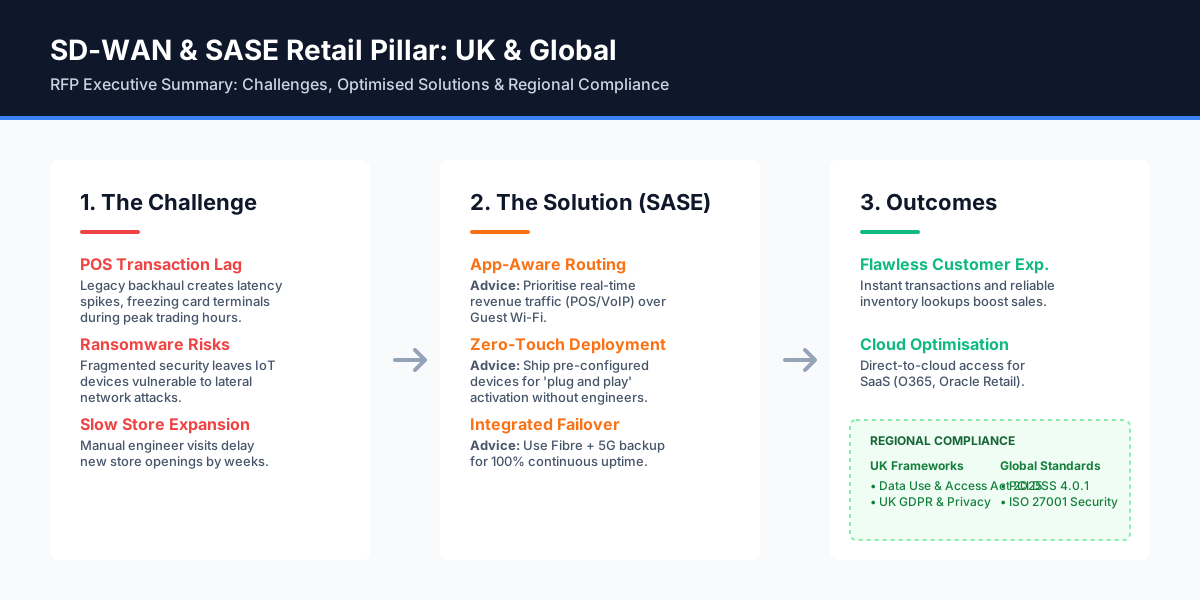
Traditional WAN architectures cannot meet retail demands for distributed operations, payment processing and real-time inventory management; however SD-WAN and SASE solutions provide the answer through application-aware routing, centralised management and integrated security for PCI DSS and GDPR compliance.
Harry Yelland
Harry conducted research into distributed retail networking architectures to create this guide. He examined the Data Use and Access Act 2025 to clarify new consumer privacy duties. He studied PCI DSS 4.0.1 requirements for secure payment processing environments. He synthesised technical SD-WAN data with real-world inventory management challenges to ensure commercial relevance.
Robert Sturt
Robert validated the technical accuracy of the zero-touch deployment sections. He ensured the SASE security recommendations align with current NCSC guidance for retailers. He verified the architectural comparisons between legacy backhaul and modern direct cloud connectivity.
- GOV.UK Data (Use and Access) Act 2025 guidance
- PCI DSS 4.0.1 Level 1 Compliance Guide ISMS.online
- NCSC and ICO guidance on cyber incidents impacting retailers
- Real-Time Inventory Optimization in Retail Using Streaming Data ResearchGate
- Why SD-WAN Is an Essential Solution for Modern Retailers BizTech
- SD-WAN Solutions for Retail Business Flexibility Vonage
- Benefits of SD-WAN for Retail and 5G Integration Cradlepoint
- How SD-WAN technology is transforming the retail industry Onecom
The Critical Role of Connectivity
Retail organisations depend on network connectivity for every transaction, inventory movement and customer interaction. When networks fail or perform poorly, customers cannot pay, staff cannot access stock information and real-time inventory synchronisation between stores and online channels breaks down resulting in lost sales, customer dissatisfaction and even loss of brand trust.
Whilst traditional retail network architectures can often struggle with operational demands (especially when considering the complexity of more modern workflows), at the same time connectivity itself, such as MPLS circuits, are expensive to deploy across hundreds of locations and inflexible when stores open, close or relocate - something that happens all too frequently in the retail sector. On top of this, backhauling all traffic through central data centres can introduce latency that degrades real-time applications (such as Inventory Management and RFID systems), leading to single points of failure, as well as the needs for guest WiFi, digital signage and IoT devices all also competing for bandwidth, which can squeeze retailer’s impact revenue-generating systems during peak periods.
Figure 1: Comparison of Legacy Backhaul vs. Modern Direct SD-WAN Architecture
However, with SD-WAN and SASE architectures, retailers can address these challenges through the likes of application-aware traffic management, supporting multiple connectivity types, which is also beneficial for resilience, and providing centrally managed security that scales across distributed branches and minimising the need for on-site expertise. For retailers, SD-WAN and SASE can offer solutions for the majority of pain-points that traditional WAN causes, alongside supporting the industry's compliance requirements.
How does the retail operating environment impact connectivity requirements?
Although there are often many common themes and demands across the retail industry, it’s easy to forget that not all retailers' needs are the same - operating across different site types, each with distinct connectivity requirements and tolerance for failure. Understanding these operational differences is essential when evaluating SD-WAN and SASE solutions, as the consequences of network failure vary dramatically depending on location type and the systems that depend on connectivity.
Convenience Stores & Small Format
DependenceContinuous connectivity for card payments, inventory updates and staff communications.
The RealityEven though, in the event of downtime, more modern card terminals can now process some transactions offline (and store them for later reconciliation), these offline capabilities have limitations such as transaction value caps and approval restrictions - leaving some instances where sales will still go amiss.
The RiskShould the store face extended network outages, these limits can be reached and may result in complete store closure in an increasingly cashless society.
Supermarkets
DependencePOS systems, digital shelf-edge labels (syncing pricing), self-service checkouts (backend validation) and inventory systems.
The RealitySupermarkets have never relied on their network more. Whilst the effect of some issues can often be swallowed by supermarkets for the betterment of customer experience (such as slow synchronisation of price labels creating discrepancies between shelf and till), other experience-based effects can be more harmful. For example, delayed self-checkout validation can be incredibly frustrating for customers and lead to lengthy queues that dissuade customers from purchases.
The RiskDirect effects on supermarkets can come from slow inventory updates that lead to stock-outs or over-ordering based on stale data - either causing lost sales potentially or over-carrying in stock.
Distribution Centres
DependenceWarehouse management systems (packing, delivery note generation, automated storage, robotic picking, sortation).
The RealityUnlike both small stores and supermarkets, distribution centres represent everything non-customer-facing. These systems are often very latency-sensitive.
The RiskWhen a distribution centre network fails, the impact can have a large-scale effect on the retailer as a whole (and not just singular shops) by stalling the movement of goods.
What are the network performance expectations for modern retail operations?
Performance expectations and requirements significantly vary based on both the type of retail network and variables such as trading patterns. Stores can often experience predictable spikes during peak periods such as Saturday afternoons, Black Friday and Christmas trading.
During these peaks, stores often push promotional content to digital signage, security systems are enabled for streaming footage, customer WiFi demand surges, staff make more stock check requests and more customer service issues are handled - all of which utilise retailer networks. Whilst stores can run entirely smoothly during off-peak times, preparing for these peak trading periods can be essential to prevent lost sales or bad customer experiences.
Primary Network Performance and Management Challenges
As with most industries, latency tolerance for retail applications differs by type:
- POS Systems: Require responsive performance but can tolerate modest latency but are partial to downtime.
- Inventory Synchronisation: Real-time synchronisation between stores, distribution centres and online channels operates on tighter margins.
When customers order online for in-store collection, inventory must be reserved immediately to prevent overselling. Higher latency creates timing issues where multiple systems may attempt to reserve the same stock. Given this, poor network design that causes issues with retailer’s application and networked systems manifests as operational problems that retailers sometimes misattribute to other causes.
For example, POS systems that are running slowly are often suffering from network congestion rather than application issues. When multiple retail systems compete for bandwidth without proper quality of service policies, transactions can take noticeably longer, however do not offer a clear tangible reason as to why. On the other hand, inventory discrepancies between channels often trace back to synchronisation delays caused by network latency or packet loss. These, alongside slow-loading product information on staff tablets or buffering promotional videos, lead to digital experiences for customers and staff alike that feel unresponsive and all degrade brand perception.
Figure 1: Application-Aware Routing ensures critical POS traffic takes the priority path.
The Solution: SD-WAN & SASE
These systems are ideal for SD-WAN and SASE’s routing capabilities, such as Quality of Service (QoS), Application Aware Routing (AAR), link aggregation and dynamic path selection, all of which utilise a variety of network underlays and enable retailers to ensure POS and inventory systems are prioritised and routing over the best performing link at any given time.
Another challenge that retailers often face is that retail networks must operate without dedicated on-site IT support, where store managers or shop owners aren't network engineers. If network equipment fails, they may be able to restart devices, but they can’t diagnose routing issues or analyse traffic policies - which becomes all the more complicated when the networked systems are running slowly but the overall network appears to still be working.
Given this, traditional networks cannot be set up or serviced efficiently in-house, often requiring external expertise to be leveraged. With SD-WAN and SASE, retailers can move to a centrally managed approach, allowing professionals to deploy and oversee all sites from one place. With tools such as zero-touch provisioning, these IT teams can configure, monitor and troubleshoot remotely. When a store opens, equipment can then arrive pre-configured and connect automatically, whilst when a store closes, disconnecting devices should be the only action required from site staff.
What are the key security and compliance drivers for retail networks?
With retail organisations often handling vast quantities of payment card data, customer personal information and employee records across distributed networks, security and regulatory compliance are non-negotiable operational requirements.
How does PCI DSS 4.0.1 compliance affect retail network architecture?
Any organisation, retail or not, that processes, stores or transmits payment card data must comply with PCI DSS standards, and with PCI DSS 4.0.1 requirements effective (including all requirements added as of March 31, 2025), retailers are now required to segment cardholder data environments from other network segments and encrypt all cardholder data during transmission across open or public networks.
For retailers, POS traffic must traverse isolated network paths or encrypted tunnels that are demonstrably separate from general corporate traffic and guest WiFi.
Figure 2: PCI DSS requires strict logical segmentation between POS systems and Public WiFi.
SD-WAN and SASE are ideal for this as, depending on the chosen vendor, often solutions support granular segmentation policies and, as with all SD-WAN and SASE solutions, these segmentations can be centrally defined and consistently enforced across hundreds or thousands of store locations without requiring on-site configuration - offering an easy way for retailers to comply with PCI DSS.
SD-WAN and SASE also often offer audit and reporting capabilities, which help with PCI DSS compliance. As PCI DSS also mandates regular security testing, vulnerability scanning and penetration testing of network infrastructure, SD-WAN and SASE can demonstrate compliance, including visibility into what traffic traversed which network paths, what security policies were applied and what encryption standards were enforced.
How do GDPR and the Data (Use and Access) Act 2025 (DUAA) impact retail data protection?
Beyond payment card data, retailers collect and process substantial customer personal data through loyalty programmes, online accounts, click-and-collect services and in-store analytics.
The UK GDPR, the Data Protection Act 2018, and the Data (Use and Access) Act 2025 (DUAA) impose legal obligations on how this data is collected, processed, stored and transmitted by retailers and they must implement appropriate measures to protect personal data.
On top of this, data residency requirements add complexity for retailers operating across multiple countries as UK GDPR restricts transfers of personal data outside the UK unless adequate safeguards are in place. Unlike traditional WAN methods, with SD-WAN and SASE solutions, retailers can dynamically route traffic to appropriate regional data centres to adhere to data sovereignty criteria.
On top of this, these solutions can offer breach notifications (which assist with UK GDPR compliance), speeding up detection of security incidents and helping to understand and minimise the scope of an attack, alongside the aforementioned reporting capabilities that can be useful when reporting a breach.
Common Cyber Threats
Retail organisations have recently seen an increase in ransomware attacks, with attackers recognising that disruption to trading operations creates immediate pressure to pay ransoms - for example:
- Point-of-sale malware attempts to intercept payment card data during transaction processing.
- Distributed denial-of-service (DDoS) attacks can disrupt online operations or overwhelm store networks during peak trading periods.
These threats require security capabilities integrated into network infrastructure rather than bolted on afterwards. SASE architectures that combine SD-WAN with integrated security functions (NGFW, CASB, intrusion prevention and malware detection) are all designed to provide widespread protection.
Whilst these features can often be ‘bolted-on’ to traditional WAN, they lack the centralised remote management and integrations to replicate SD-WAN/SASE’s complete network visibility, meaning that these solutions cannot be easily modified or deployed. Further to this, with all network data reporting in one location, all audits and performance/security management can be easily gathered by those with the expertise to use it.
What specific capabilities do retail organisations need from SD-WAN and SASE solutions?
As we’ve highlighted above, many of the retail sector’s network pain-points come from distributed site architectures, varied location types, limited on-site IT expertise, regulatory compliance efforts and the need to support both revenue-generating and customer-facing applications reliably. Given this, retailers should consider the following capabilities that SD-WAN and SASE have to offer that are essential for meeting their needs:
How can application-aware routing prioritise revenue-generating retail traffic?
Retail networks must prioritise traffic based on business impact rather than treating all applications equally, which is where SD-WAN’s Application-Aware Routing comes into play. POS transactions, inventory synchronisation and payment processing should always receive priority over guest WiFi, promotional content downloads and non-critical updates, and with application-aware routing capabilities, SD-WAN can identify traffic types and apply appropriate quality of service policies automatically - with all traffic prioritisation policies defined centrally and enforced consistently across all locations. This means that, when retailer’s networks face congestion during peak trading periods, the system should protect revenue-generating applications like POS and inventory management systems without requiring manual intervention.
Why is zero-touch deployment essential for centrally managed retail networks?
Store-level deployment cannot depend on on-site technical expertise, therefore SD-WAN offers the solution through pre-configured deployments, where equipment arrives and connects automatically to register with central management systems (without local intervention from store staff who are managing customers and trading operations).
Figure 1: Zero-Touch Deployment flow minimising on-site expertise requirements.
Central management must provide complete visibility into performance, security events and configuration status across all locations, allowing for audits for regulatory reasons such as GDPR and PCI DSS, with IT teams also able to diagnose issues, adjust policies and monitor performance remotely without relying on store staff to provide information or execute commands.
How does SD-WAN ensure multi-site resilience and automatic failover?
With SD-WAN able to support multiple transport types (including fibre, broadband and 4G/5G), with automatic failover when primary connectivity fails, retailers can mitigate downtime issues on their primary links. Depending on the store size this may vary, as small format stores might only justify mobile broadband backup, meanwhile large supermarket locations might require diverse fibre paths and sub-second failover capabilities to maintain business continuity.
How does network segmentation improve both retail security and regulatory compliance?
To comply with the likes of PCI DSS and GDPR, retailers must consider how their network is segmented and how they minimise risks to data. Many retailers now offer guest WiFi to provide internet access for user experience benefits but must ensure this doesn’t enable access to internal systems. SD-WAN can support this through granular segmentation policies that can isolate different traffic types, enforce access controls based on device identity/user authentication and maintain appropriate security boundaries across all site types.
What should retailers consider when beginning an SD-WAN or SASE procurement process?
With so many vendors and managed service providers offering SD-WAN and SASE that claim to solve all of retails’ network issues, finding the right one for your business can be difficult. One way of deciphering the best fit is through a structured RFP, tailored to your specific network requirements, operational model and compliance obligations.
Why is a structured RFP critical for selecting the right retail network vendor?
Retail organisations typically operate dozens or hundreds of locations with varying connectivity needs, making informal vendor selection processes impractical. A structured RFP ensures that all vendors respond to the same requirements, enabling fair comparison and reducing the risk of discovering capability gaps after contract signature.
Figure 2: Key Retail-Specific Requirements for SD-WAN RFPs.
Sector-Specific Requirements Often Overlooked
Store portfolio volatility
Netify recommends that retail RFPs explicitly define expected rates of store openings, closures and relocations over the contract term, with contractual obligations for rapid provisioning and clean decommissioning. Solutions requiring lengthy lead times for circuit installation or complex decommissioning processes can delay or even prevent store openings and therefore RFPs should specify maximum acceptable provisioning times for new locations and decommissioning procedures that don't leave retailers paying for unused circuits.
Differentiated resilience by site type
Retailers tend to specify uniform connectivity standards across all locations, leading to over-investment in small sites and under-investment in critical locations. RFPs should define site tiers with different resilience requirements, backup connectivity types and failover performance targets, allowing vendors to propose cost-effective solutions that protect revenue appropriately without creating unnecessary costs.
Peak period performance
RFPs typically specify average bandwidth requirements without acknowledging that retail networks experience predictable demand spikes during peak trading periods. Requirements should specify peak period bandwidth needs and define acceptable performance degradation during congestion, with vendors explaining how their solutions handle traffic prioritisation when demand exceeds capacity.
Franchise and multi-tenancy requirements
RFPs should specify whether franchisees will use the same network infrastructure and what security boundaries must exist between corporate/franchise operations.
Compliance audit support
RFPs should require vendors to explain how their solutions support PCI DSS compliance audits and adhere to GDPR standards, as well as what logging and reporting capabilities are provided for internal processes and whether they can produce compliance evidence across all locations from central management systems.
How do network challenges differ between enterprise and mid-market retailers?
Whilst we’ve detailed many common issues experienced by the retail industry as a whole, retail organisations at different scales face fundamentally different network challenges and understanding these distinctions is essential for appropriate solution selection.
Figure 3: Structural differences driving network decisions for Enterprise vs. Mid-Market retailers.
What are the specific network requirements for enterprise-scale retail organisations?
Enterprise retailers typically operate hundreds or thousands of locations with dedicated network operations centres and in-house IT teams, alongside more complex network architectures (including MPLS backbones, dedicated security operations centres and network monitoring infrastructure). Given this, SD-WAN RFP procurement decisions will likely involve multiple stakeholders across IT, security, finance and operations, with formal approval processes and multi-year strategic planning cycles.
One consideration that tends to be more specific to enterprise retailers is that they often run multiple brands or formats of network infrastructure under a single corporate structure, requiring network solutions that support multi-tenancy and differentiated service levels across different stores. This may mean that, in the event of an SD-WAN RFP they should detail any contractual obligations to maintain relationships with multiple vendors and service providers.
What unique connectivity challenges do mid-market retailers face?
Mid-market retailers operate with leaner IT teams, network decisions are typically made by smaller teams with broader responsibilities, requiring solutions that are more simplified. These organisations typically lack dedicated security operations centres and therefore should consider managed service provider assistance or tailoring RFPs for solutions with integrated security capabilities and outsourced security monitoring.
How does Netify help retail businesses simplify vendor selection and the RFP process?
Netify operates as a neutral SD-WAN and SASE marketplace that helps retail organisations navigate vendor selection without vendor bias - providing our intelligent RFP builder tool that guides your retail business through defining specific requirements, covering network topology, site types, compliance obligations, resilience expectations and operational constraints.
This structured approach reduces the time taken to create an effective RFP and ensures that requirements are comprehensively specified before vendors are engaged. Our marketplace connects retailers with curated SD-WAN and SASE vendors and managed service providers, who will each respond to the same structured RFP, enabling direct comparison based on consistent criteria. We support both enterprise and mid-market retailers, with RFP templates and guidance tailored to the full range of retail-specific requirements.
What sections should be included within your Retail SD-WAN and SASE RFP?
| RFP Section | Critical Procurement Question | Strategic Rationale and Authority |
|---|---|---|
| PCI Compliance | Describe how the SD-WAN design reduces PCI DSS scope by segmenting POS, guest Wi-Fi, and retail IoT at the store edge. | Retailers often inherit scope creep when payment and IoT traffic share network resources. Source: PCI DSS Standard |
| Peak Trading Performance | Explain how the solution handles seasonal spikes such as Black Friday using app-aware QoS and path controls. | The network stack must be engineered for surges in POS and inventory traffic rather than average loads. Source: NCSC Retail Guidance |
| Payment Continuity | Detail failover times to 4G/5G and how the design avoids breaking payment sessions during circuit outages. | Outages cause immediate revenue loss; payment authorisation must remain persistent. Source: NCSC Continuity |
| Retail IoT Security | Describe segmentation for CCTV, digital signage, and sensors, particularly for hardware unable to support security agents. | Unmanaged IoT devices are common pivot points for attackers to reach payment systems. Source: NIST Zero Trust Architecture |
| Identity & Vendor Access | Explain how ZTNA and just-in-time access secure third-party maintenance for POS and store systems. | Unmanaged vendor access is a frequent breach pathway into retail store networks. Source: NIST SP 800-207 |
| Regional Privacy | Provide a statement on how the service handles customer identifiers in telemetry for UK GDPR and CCPA/CPRA. | Retailers must understand what telemetry data exists to keep the compliance surface manageable. Source: UK GDPR Guidance |
| Store Rollout Efficiency | Describe the secure zero-touch provisioning process for pop-up kiosks and concessions. | Temporary sites must not use shortcuts that introduce long-term exposure for the main estate. Source: PCI Security Standards |
| Data Residency | Confirm the ability to restrict traffic inspection and log storage to the UK, US, or Canada. | Contractual constraints often prohibit cross-border processing of customer loyalty data. Source: Canada PIPEDA Standards |
Frequently Asked Questions
We at Netify find that the primary benefit of SD-WAN for retailers is the ability to minimise distributed site latency issues through application-aware routing and remote management from centralised orchestration and zero-touch deployment capabilities. These are ideal for ensuring that revenue-generating systems, such as Point of Sale (POS) and real-time inventory tracking, are prioritised over non-critical traffic like guest WiFi, whilst new or existing sites can be managed without on-site expertise.
SASE (Secure Access Service Edge) is essential because it converges networking and security into a single cloud-based framework. For retailers, this not only reduces the complexity of managing both of these facets across hundreds of store locations, but is also critical for protecting against sector-specific threats – such as ransomware and POS malware which have been on the rise in recent years.
SD-WAN assists with PCI DSS 4.0.1 compliance by implementing network security controls, such as granular network segmentation and isolating the Cardholder Data Environment (CDE) from other store traffic.
The Data (Use and Access) Act 2025 (DUAA) mandates that UK retailers implement technical measures to protect personal data during both transmission and processing. Both SD-WAN and SASE architectures help meet these requirements through the likes of automated encryption and improved data visibility capabilities.
High network latency causes synchronisation failures between physical stores and online channels - when systems fail to sync in real-time, it leads to duplicate stock reservations and lost sales, directly impacting customer trust and brand reputation.
A retail-specific RFP should include clear requirements for peak bandwidth handling during periods (such as Black Friday or Saturday afternoons) and specific vendor questions regarding their ability to support multi-site resilience and automatic failover.