
SD-WAN and SASE Network Security for Healthcare
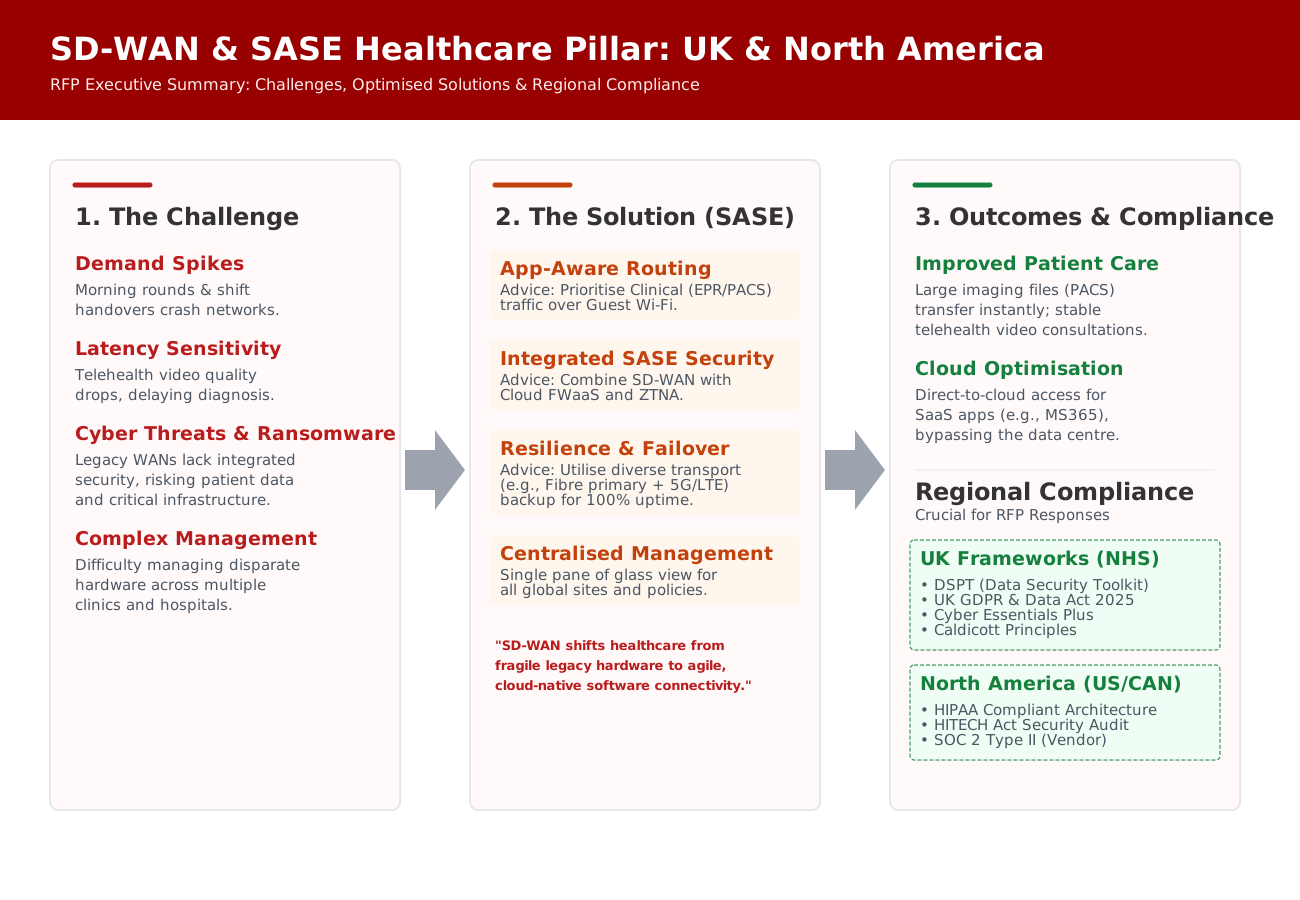
Legacy WAN architectures cannot support healthcare's demands for clinical application performance, multi-site connectivity and regulatory compliance, however SD-WAN and SASE solutions provide the answer through application-aware routing, centralised management and integrated security for NHS Data Security and Protection Toolkit (DSPT), UK GDPR and Caldicott Principle compliance.
Harry Yelland
Harry conducted in-depth research across technical and regulatory domains to develop this guide. He analysed healthcare-specific networking requirements, reviewed DSPT and CAF-aligned compliance frameworks, investigated real-world UK healthcare cyber incidents such as the Synnovis attack, and synthesised vendor-neutral SD-WAN and SASE explanations to support procurement needs. His approach combined sector reports, standards documentation, and peer-reviewed insights to ensure relevance and accuracy.
Robert Sturt
Robert validated all factual claims, legal references, compliance expectations, and technical explanations, ensuring accuracy and alignment with current UK healthcare networking and cybersecurity frameworks.
- National Audit Office Investigation WannaCry cyber attack and the NHS
- UK National Cyber Security Centre Cyber Assessment Framework
- SASE Cybersecurity for the Healthcare Sector Netify Insights
- Impact of cyberattacks on primary care Lancet Digital Health
- Data Use and Access Act 2025 health sector perspective
- SD-WAN vs SASE Palo Alto Networks
- How to Choose SD-WAN for Healthcare Netify Insights
- NHS Data Security and Protection Toolkit
- NHS DSPT CAF aligned guidance
- Synnovis cyber attack statement NHS England
● Executive Summary
Legacy WAN architectures cannot support healthcare's demands for clinical application performance, multi-site connectivity and regulatory compliance, however SD-WAN and SASE solutions provide the answer through application-aware routing, centralised management and integrated security for NHS Data Security and Protection Toolkit (DSPT), UK GDPR and Caldicott Principle compliance.
● Impact on Patient Care
Healthcare organisations depend on network connectivity for every patient interaction, clinical decision and administrative process. When networks fail or perform poorly, clinicians cannot access patient records, diagnostic images experience delays, telehealth consultations freeze mid-session and critical alerts from connected medical devices fail to reach the appropriate staff - resulting in delayed treatment decisions, compromised patient safety and potential regulatory breaches.
● Operational Strain
Whilst traditional healthcare network architectures can often struggle with operational demands (especially when considering the complexity of modern digital health workflows), at the same time connectivity itself, such as MPLS circuits, are expensive to deploy across geographically dispersed sites and inflexible when services relocate or new facilities open - something that happens frequently as healthcare providers adapt to changing population needs and commissioning arrangements. On top of this, backhauling all traffic through central data centres can introduce latency that degrades real-time applications (such as Picture Archiving and Communication Systems and telehealth platforms), leading to single points of failure, as well as the needs for guest WiFi, medical IoT devices and remote working staff all competing for bandwidth, which can squeeze capacity for clinically critical systems during peak periods.
● SD-WAN & SASE Solution
However, with SD-WAN and SASE architectures, healthcare organisations can address these challenges through the likes of application-aware traffic management, supporting multiple connectivity types, which is also beneficial for resilience, and providing centrally managed security that scales across distributed sites and minimising the need for on-site expertise. For healthcare providers, SD-WAN and SASE can offer solutions for the majority of pain-points that traditional WAN causes, alongside supporting the sector's regulatory requirements.
How does the healthcare operating environment impact connectivity requirements?
Although there are often many common themes and demands across the healthcare sector, it's easy to forget that not all healthcare organisations' needs are the same - operating across different site types, each with distinct connectivity requirements and tolerance for failure. Understanding these operational differences is essential when evaluating SD-WAN and SASE solutions, as the consequences of network failure vary dramatically depending on location type and the clinical systems that depend on connectivity.
● GP Surgeries & Primary Care
GP surgeries and primary care sites depend on continuous connectivity for electronic patient records, e-prescribing and referral systems. Even though some clinical systems offer limited offline functionality for appointment notes, these capabilities have significant restrictions - clinicians cannot access patient history, medication records or test results without live connectivity.
Extended network outages can force practices to revert to paper-based processes, creating patient safety risks from incomplete information and administrative backlogs that take days to clear.
● Acute Hospitals
As to be expected with larger facilities, acute hospitals introduce considerably more complex performance requirements - electronic patient records remain critical, however these sites now run the likes of Picture Archiving and Communication Systems (PACS) requiring rapid transfer of diagnostic images (often several hundred megabytes per study), real-time patient monitoring systems transmitting continuous vital signs, and laboratory information systems coordinating thousands of test results daily.
And whilst the effect of some issues can sometimes be absorbed by hospitals for the betterment of patient experience (such as slightly delayed non-urgent results), other effects can be directly harmful. For example, slow PACS performance means radiologists cannot review diagnostic images promptly, potentially delaying time-critical diagnoses. Furthermore, more direct effects on hospitals can come from delayed critical alerts from patient monitoring systems failing to reach clinical staff in time - either compromising patient safety or requiring manual workarounds that consume nursing time.
● Community Healthcare
Unlike both primary care sites and acute hospitals, community healthcare facilities represent a dispersed operational model. District nursing teams, community mental health services and rehabilitation centres often operate from smaller sites with minimal IT support. Within these, network reliability is essential for mobile clinicians accessing records during home visits (often via 4G/5G), secure messaging between care teams and video consultations with patients who cannot travel.
When community site networks fail, the impact can cascade across patient pathways - discharge planning stalls, medication reviews are delayed and vulnerable patients miss essential monitoring.
Network Performance, Management & Compliance
Performance expectations and requirements significantly vary based on both the type of healthcare network and variables such as clinical activity patterns.
● Demand Spikes & Latency
Hospitals experience predictable demand spikes during morning ward rounds, afternoon outpatient clinics and shift handovers - during these peaks, multiple clinicians simultaneously access patient records, diagnostic images are pulled for multidisciplinary team meetings, pharmacy systems process medication orders and administrative staff handle referrals and discharges, all within the healthcare networks. Whilst sites can run entirely smoothly during quieter periods, preparing for these peak clinical activity periods can be essential to prevent delayed care or patient safety incidents.
What are the primary network performance and management challenges for healthcare providers?
- Electronic patient record systems: Require responsive performance but can tolerate modest latency - though extended response times frustrate clinicians and reduce consultation efficiency.
- Real-time clinical systems: Operate on tighter margins. When a patient deteriorates on a ward, early warning score alerts must reach clinical staff immediately.
- Telehealth video consultations: Require consistent low latency to maintain conversation quality - higher latency creates awkward delays that undermine clinical rapport and diagnostic confidence.
- PACS image retrieval: For time-critical cases (such as suspected stroke) cannot tolerate delays when every minute affects patient outcomes.
Given this, poor network design that causes issues with healthcare applications and networked systems manifests as operational problems that organisations sometimes misattribute to other causes. For example, electronic patient record systems that are running slowly are often suffering from network congestion rather than application issues. When multiple clinical systems compete for bandwidth without proper quality of service policies, record access can take noticeably longer, however does not offer a clear tangible reason as to why. On the other hand, delayed laboratory results or radiology reports often trace back to synchronisation delays caused by network latency or packet loss. These, alongside slow-loading patient information on clinical tablets or freezing telehealth video, lead to digital experiences for clinicians and patients alike that feel unresponsive and all degrade care quality.
● The SD-WAN Solution
These clinical systems are ideal candidates for SD-WAN and SASE's routing capabilities, such as Quality of Service (QoS), Application Aware Routing (AAR), link aggregation and dynamic path selection, all of which utilise a variety of network underlays and enable healthcare organisations to ensure that patient-critical applications like EPR access, PACS retrieval and monitoring alerts are prioritised and routing over the best performing link at any given time.
Another challenge that healthcare organisations often face is that healthcare networks must frequently operate without dedicated on-site IT support - practice managers and ward clerks aren't network engineers. If network equipment fails, they may be able to restart devices, but they can't diagnose routing issues or analyse traffic policies. This becomes all the more complicated when the networked systems are running slowly but the overall network appears to still be working and, given this, traditional networks cannot be set up or serviced efficiently in-house, often requiring external expertise to be leveraged.
With SD-WAN and SASE, healthcare organisations can move to a centrally managed approach, allowing professionals to deploy and oversee all sites from one place. With tools such as zero-touch provisioning, these IT teams can configure, monitor and troubleshoot remotely. When a new clinic opens, equipment can then arrive pre-configured and connect automatically, whilst when a site closes, disconnecting devices should be the only action required from site staff.
● Security & Compliance
What are the key security and compliance drivers for healthcare networks? With healthcare organisations handling vast quantities of sensitive patient data, clinical records and staff information across distributed networks, security and regulatory compliance are non-negotiable operational requirements.
How does NHS Data Security and Protection Toolkit (DSPT) compliance affect healthcare network architecture?
Any organisation that processes NHS patient data must complete the Data Security and Protection Toolkit annually, demonstrating compliance with the ten National Data Guardian standards. The current DSPT cycle (Version 8, 2025-26) requires final submission by 30 June 2026, with organisations required to submit interim baseline assessments by 31 December. These requirements mandate that organisations understand what personal data they hold, ensure data is only accessible to authorised users, maintain secure systems and report security incidents appropriately. For healthcare providers, this means network architectures must support granular access controls, encrypted data transmission and comprehensive audit logging.
SD-WAN and SASE are ideal for this as, depending on the chosen vendor, solutions often support granular segmentation policies and, as with all SD-WAN and SASE solutions, these segmentations can be centrally defined and consistently enforced across dozens or hundreds of healthcare sites without requiring on-site configuration - offering a straightforward way for healthcare organisations to demonstrate DSPT compliance. SD-WAN and SASE also often offer audit and reporting capabilities, which help with DSPT compliance. As the Toolkit requires evidence of security controls, network monitoring and incident response, SD-WAN and SASE can demonstrate compliance, including visibility into what traffic traversed which network paths, what security policies were applied and what encryption standards were enforced.
Strategic Overview & Technical Deep Dive
Select a topic to explore regulations, threats, technical capabilities, and procurement strategies.
How do UK GDPR, the Caldicott Principles and the Data (Use and Access) Act 2025 (DUAA) impact healthcare data protection?
Beyond the DSPT, healthcare organisations must comply with UK GDPR (which designates health data as a 'special category' requiring additional protections), the eight Caldicott Principles governing confidential patient information, and the Data (Use and Access) Act 2025 (DUAA) which received Royal Assent on 19 June 2025. The DUAA amends (but does not replace) the UK GDPR and Data Protection Act 2018, with provisions being phased in between June 2025 and June 2026 - the ICO continues to publish updated guidance as provisions come into effect.
The Caldicott Principles specifically require that access to patient-identifiable information is on a strict need-to-know basis and that everyone with access understands their responsibilities.
Unlike traditional WAN methods, with SD-WAN and SASE solutions, healthcare organisations can implement role-based access controls at the network level and dynamically route traffic to appropriate systems based on data classification.
On top of this, these solutions can offer breach notification capabilities (which assist with UK GDPR compliance), speeding up detection of security incidents and helping to understand and minimise the scope of an attack, alongside the aforementioned reporting capabilities that can be useful when reporting a breach to the Information Commissioner's Office.
What are the most common cyber threats facing the healthcare sector today?
Healthcare organisations have seen a significant increase in ransomware attacks, with UK healthcare experiencing a 40% increase in early 2025 compared to the same period in 2024. Attackers recognise that disruption to clinical operations creates immediate pressure to pay ransoms - the 2017 WannaCry attack demonstrated the devastating impact on NHS services when clinical systems become unavailable, affecting over 80 hospital trusts, cancelling nearly 20,000 appointments and costing an estimated £92 million.
More recently, the June 2024 Synnovis attack disrupted pathology services across London hospitals for months, with the NHS linking patient harm directly to the incident.
For example:
- Ransomware attacks that encrypt patient records and clinical systems, forcing organisations to cancel appointments and divert ambulances.
- Phishing attacks targeting clinical and administrative staff to gain initial network access.
- Medical device vulnerabilities where connected equipment (infusion pumps, imaging systems, patient monitors) may run outdated software with known security flaws.
These healthcare-specific threats - particularly attacks targeting patient data and life-critical clinical systems - require security capabilities that are integrated into network infrastructure rather than bolted on afterwards, where delays in deployment or configuration gaps can leave clinical systems exposed.
SASE architectures that combine SD-WAN with integrated security functions (NGFW, CASB, intrusion prevention and malware detection) provide healthcare organisations with the ability to protect clinical endpoints, segment medical IoT devices and enforce consistent security policies across GP surgeries, hospitals and community sites from a single management platform.
Whilst these security features can often be 'bolted-on' to traditional WAN, they lack the centralised remote management required for healthcare's distributed estate - meaning security policies cannot be consistently enforced across hundreds of clinical sites, and visibility into threats affecting patient data or clinical systems is fragmented.
With SD-WAN and SASE, all network and security data reports to one location, allowing healthcare IT teams to monitor for threats to patient information, maintain DSPT audit trails and respond to incidents affecting clinical operations without relying on site staff.
What specific capabilities do healthcare organisations need from SD-WAN and SASE solutions?
As we've highlighted above, many of the healthcare sector's network pain-points come from distributed site architectures, varied location types, limited on-site IT expertise, regulatory compliance efforts and the need to support both clinically critical and patient-facing applications reliably.
Given this, healthcare organisations should consider the following capabilities that SD-WAN and SASE have to offer that are essential for meeting their needs:
How can application-aware routing prioritise clinically critical healthcare traffic?
Healthcare networks must prioritise traffic based on clinical impact rather than treating all applications equally, which is where SD-WAN's Application-Aware Routing comes into play.
Electronic patient record access, PACS image retrieval, patient monitoring alerts and e-prescribing should always receive priority over guest WiFi, administrative web browsing and non-urgent updates, and with application-aware routing capabilities, SD-WAN can identify traffic types and apply appropriate quality of service policies automatically - with all traffic prioritisation policies defined centrally and enforced consistently across all locations.
This means that, when healthcare networks face congestion during peak clinical activity periods, the system should protect clinically critical applications without requiring manual intervention.
Why is zero-touch deployment essential for centrally managed healthcare networks?
Site-level deployment cannot depend on on-site technical expertise, therefore SD-WAN offers the solution through pre-configured deployments, where equipment arrives at a GP surgery or community clinic and connects automatically to register with central management systems - without requiring intervention from practice managers, ward clerks or reception staff who are focused on patient care rather than network configuration.
Central management must provide complete visibility into performance, security events and configuration status across all locations, allowing for audits for regulatory reasons such as DSPT and UK GDPR, with IT teams also able to diagnose issues, adjust policies and monitor performance remotely without relying on site staff to provide information or execute commands.
How does SD-WAN ensure multi-site resilience and automatic failover?
With SD-WAN able to support multiple transport types (including fibre, broadband and 4G/5G), with automatic failover when primary connectivity fails, healthcare organisations can mitigate downtime issues on their primary links.
Depending on the site type this may vary, as small GP surgeries might only justify mobile broadband backup, meanwhile acute hospital sites might require diverse fibre paths and sub-second failover capabilities to maintain clinical system availability for patient safety.
How does network segmentation improve both healthcare security and regulatory compliance?
To comply with the likes of DSPT and UK GDPR, healthcare organisations must consider how their network is segmented and how they minimise risks to patient data.
Many healthcare sites now offer patient WiFi for waiting areas but must ensure this doesn't enable access to clinical systems. Medical IoT devices (infusion pumps, patient monitors, imaging equipment) often require network access but must be isolated from general network traffic.
SD-WAN can support this through granular segmentation policies that can isolate different traffic types, enforce access controls based on device identity/user authentication and maintain appropriate security boundaries across all site types.
What should healthcare organisations consider when beginning an SD-WAN or SASE procurement process?
With so many vendors and managed service providers offering SD-WAN and SASE that claim to solve all of healthcare's network issues, finding the right one for your organisation can be difficult.
One way of deciphering the best fit is through a structured RFP, tailored to your specific network requirements, operational model and compliance obligations.
Why is a structured RFP critical for selecting the right healthcare network vendor?
Healthcare organisations typically operate dozens or hundreds of locations with varying connectivity needs - from GP surgeries requiring basic resilience to acute hospitals demanding sub-second failover for patient safety systems - making informal vendor selection processes impractical.
A structured RFP ensures that all vendors respond to the same healthcare-specific requirements (including DSPT compliance support, clinical application prioritisation and medical IoT segmentation), enabling fair comparison and reducing the risk of discovering capability gaps after contract signature that could affect patient care or regulatory compliance.
Sector-Specific Requirements Often Overlooked
Service reconfiguration and site changes - Netify recommends that healthcare RFPs explicitly define expected rates of site openings, closures and service relocations over the contract term, with contractual obligations for rapid provisioning and clean decommissioning.
Healthcare services frequently reconfigure in response to commissioning decisions, population health needs and estate rationalisation programmes.
Solutions requiring lengthy lead times for circuit installation or complex decommissioning processes can delay service changes and therefore RFPs should specify maximum acceptable provisioning times for new locations and decommissioning procedures that don't leave organisations paying for unused circuits.
Differentiated resilience by site type - Healthcare organisations tend to specify uniform connectivity standards across all locations, leading to over-investment in small sites and under-investment in critical locations.
RFPs should define site tiers with different resilience requirements - acute hospitals handling emergency care require near-continuous availability, whilst community sites might tolerate brief outages with appropriate clinical workarounds.
Backup connectivity types and failover performance targets should vary accordingly, allowing vendors to propose cost-effective solutions that protect clinical services appropriately without creating unnecessary costs.
Peak period performance - RFPs typically specify average bandwidth requirements without acknowledging that healthcare networks experience predictable demand spikes during peak clinical activity periods.
Requirements should specify peak period bandwidth needs (morning ward rounds, outpatient clinics, MDT meetings) and define acceptable performance degradation during congestion, with vendors explaining how their solutions handle traffic prioritisation when demand exceeds capacity.
Integrated Care System and multi-organisation requirements - RFPs should specify whether partner organisations within an Integrated Care System will share network infrastructure and what security boundaries must exist between different NHS trusts, primary care networks and social care providers.
Healthcare increasingly operates across organisational boundaries, and network solutions must support secure information sharing whilst maintaining appropriate access controls.
Compliance audit support and supplier assurance - RFPs should require vendors to explain how their solutions support DSPT completion and UK GDPR compliance, as well as what logging and reporting capabilities are provided for internal processes and whether they can produce compliance evidence across all locations from central management systems.
Notably, the DSPT 2025-26 cycle now requires mandatory independent audits for IT suppliers to the NHS (Category 2 organisations), meaning healthcare organisations should verify their chosen vendors' own DSPT compliance status and audit readiness as part of the procurement process.
How do network challenges differ between large and mid-market healthcare organisations?
Whilst we've detailed many common issues experienced by the healthcare sector as a whole, healthcare organisations at different scales face fundamentally different network challenges and understanding these distinctions is essential for appropriate solution selection.
What are the specific network requirements for large healthcare organisations?
Large NHS trusts and integrated care systems typically operate hundreds of locations with dedicated IT departments and in-house networking teams, alongside more complex network architectures (including N3/HSCN connectivity, dedicated security operations centres and enterprise network monitoring infrastructure).
Given this, SD-WAN RFP procurement decisions will likely involve multiple stakeholders across IT, clinical informatics, information governance and finance, with formal approval processes, business case requirements and multi-year strategic planning cycles.
One consideration that tends to be more specific to large healthcare organisations is that they often operate multiple service lines (acute, community, mental health) under a single organisational structure, requiring network solutions that support differentiated service levels across different clinical settings.
This may mean that, in the event of an SD-WAN RFP they should detail any existing contractual obligations with Health and Social Care Network (HSCN) providers and regional shared service arrangements.
What unique connectivity challenges do mid-market healthcare organisations face?
Mid-market healthcare providers - including smaller NHS trusts, GP federations, private hospital groups and care home operators - operate with leaner IT teams, network decisions are typically made by smaller teams with broader responsibilities, requiring solutions that are more simplified.
These organisations typically lack dedicated security operations centres and therefore should consider managed service provider assistance or tailoring RFPs for solutions with integrated security capabilities and outsourced security monitoring.
How does Netify help healthcare organisations simplify vendor selection and the RFP process?
Netify operates as a neutral SD-WAN and SASE marketplace that helps healthcare organisations navigate vendor selection without vendor bias - providing our intelligent RFP builder tool that guides your healthcare organisation through defining specific requirements, covering network topology, site types, compliance obligations, resilience expectations and operational constraints.
This structured approach reduces the time taken to create an effective RFP and ensures that requirements are comprehensively specified before vendors are engaged.
Our marketplace connects healthcare organisations with curated SD-WAN and SASE vendors and managed service providers, who will each respond to the same structured RFP, enabling direct comparison based on consistent criteria.
We support both large NHS organisations and mid-market healthcare providers, with RFP templates and guidance tailored to the full range of healthcare-specific requirements.
What sections should be included within your Healthcare SD-WAN and SASE RFP?
| Pillar | RFP Question Summary | Rationale and Regulatory Sources |
|---|---|---|
| Clinical Performance | Detail how the solution prioritises EHR, PACS, imaging, and telehealth traffic across MPLS and 5G. | Safety critical traffic requires low jitter and zero packet loss to maintain diagnostic integrity. NHS DCB0129 Standard HHS HICP Guidance |
| Protocol Support | Confirm support for DICOM, HL7, and FHIR protocols without issues relating to MTU or asymmetric routing. | Medical protocols behave differently than generic SaaS traffic and often fail under standard WAN policies. HSCC Cybersecurity Practices |
| UK Safety Standards | Map network and security policy changes to DCB0129 and DCB0160 clinical risk management standards. | Statutory obligations require healthcare organisations to manage clinical safety risks from network services. NHS Clinical Risk Management |
| Compliance Mapping | Provide a mapping for NHS DSPT (CAF aligned) and HIPAA technical safeguards (45 CFR 164.312). | Statutory compliance requires clear traceability between network controls and regional data laws. NHS DSPT Toolkit HIPAA 45 CFR 164.312 |
| IoMT Security | Describe the segmentation model for medical hardware that cannot support security agents or frequent patching. | Unmanaged clinical devices are primary breach vectors requiring network level isolation. FDA Medical Device Cybersecurity |
| Identity & Access | Explain ZTNA enforcement for clinicians and support for "break glass" emergency access. | Clinical workflows require rapid entry during emergencies without creating permanent security gaps. ICO Special Category Data |
| Threat Protection | Detail DNS security and SWG policies specifically tuned for healthcare vendors and clinical allowlists. | Generic security policies often disrupt essential clinical portals and telehealth sessions. HSCC Threat Alignment |
| Data Residency | Confirm ability to restrict traffic inspection and log residency to specific regions like the UK, US, or Canada. | Healthcare contracts often mandate strict data residency to comply with local privacy statutes. Canada PIPEDA / PHIPA |
Frequently Asked Questions
Common questions regarding healthcare network architecture, compliance, and procurement.