
SD-WAN and SASE for Financial Services
Legacy WAN architectures cannot support financial services' demands for ultra-low latency trading, multi-site connectivity and regulatory compliance. However, SD-WAN and SASE solutions provide the answer through application-aware routing, centralised management and integrated security for FCA operational resilience (PS21/3), PCI DSS 4.0.1 and UK GDPR compliance.
Create your SD-WAN and SASE RFP for UK and North American businesses. Publish to 30+ vendors and service providers and get responses.
Create your free account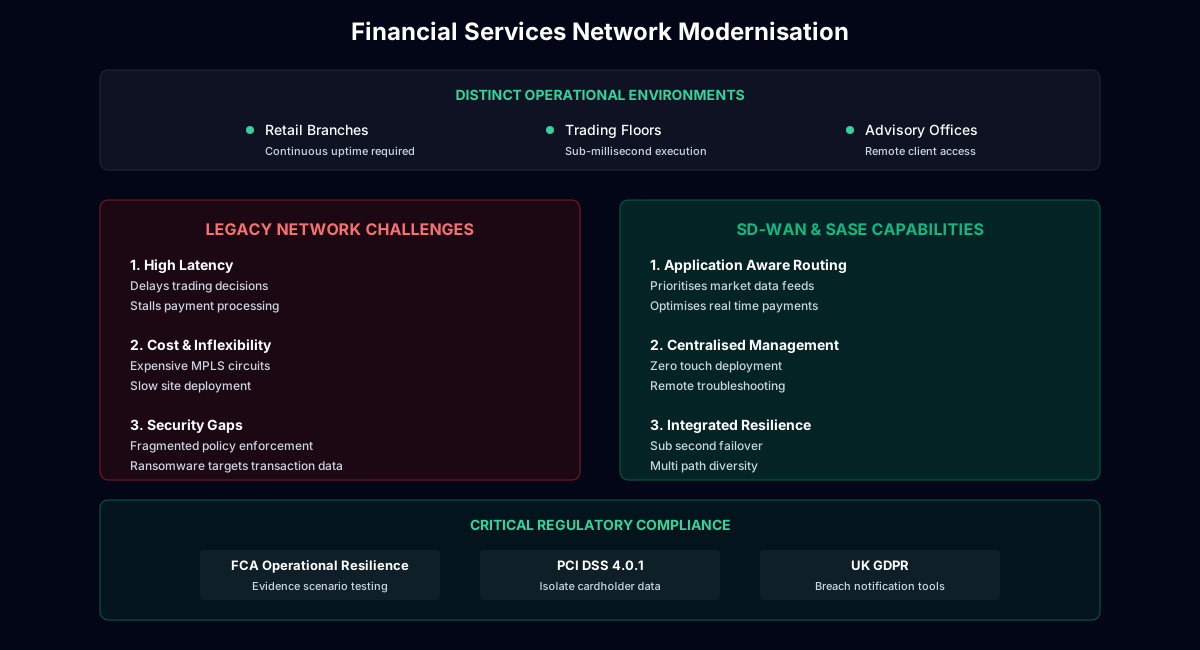
How does the financial services operating environment impact connectivity requirements?
Although there are often many common themes and demands across the financial services sector, it's easy to forget that not all financial services organisations' needs are the same - operating across different site types, each with distinct connectivity requirements and tolerance for failure.
Understanding these operational differences is essential when evaluating SD-WAN and SASE solutions, as the consequences of network failure vary dramatically depending on location type and the transaction-critical systems that depend on connectivity.
Retail Bank Branches
Bank branches depend on continuous connectivity for core banking systems, payment processing and customer service applications. Even though some branch systems offer limited offline functionality for basic enquiries, these capabilities have significant restrictions - staff cannot access customer account histories, process transactions or approve lending decisions without live connectivity.
Extended network outages can force branches to turn customers away or revert to manual processes, creating customer dissatisfaction and compliance risks from incomplete transaction records that require significant remediation.
Trading Floors & Investment Offices
As to be expected with larger facilities, trading floors and investment management offices introduce considerably more complex performance requirements. Core banking systems remain critical, however these sites now run the likes of trading platforms requiring sub-millisecond execution speeds, real-time market data feeds processing thousands of price updates per second, and risk management systems coordinating position monitoring across multiple asset classes.
And whilst the effect of some issues can sometimes be absorbed by business’s for the betterment of client experience (such as slightly delayed non-urgent reporting), other effects can be directly harmful. For example, slow trading platform performance means traders cannot execute orders at intended prices, potentially resulting in significant financial losses. Furthermore, delayed market data feeds failing to reach trading desks in time either compromise trading decisions or require manual workarounds that consume valuable analyst time.
Wealth Management & Advisory
Unlike both retail branches and trading floors, wealth management and advisory offices represent a more dispersed operational model. Financial advisers, relationship managers and client service teams often operate from smaller regional offices with minimal IT support.
Within these, network reliability is essential for advisers accessing portfolio management systems during client meetings (often via secure connections), secure messaging between advisory teams and video consultations with high-net-worth clients who expect seamless digital experiences. When regional office networks fail, the impact can cascade across client relationships - portfolio reviews are delayed, investment recommendations cannot be actioned and client confidence in the business's operational capabilities diminishes.
What are the network performance expectations for modern financial services operations?
Performance expectations and requirements significantly vary based on both the type of financial services network and variables such as market activity patterns.
Trading floors experience predictable demand spikes during market open, close and major economic announcements - during these peaks, multiple traders simultaneously execute orders, market data feeds process unprecedented volumes, risk management systems calculate real-time exposures and settlement systems handle transaction confirmations, all within financial services networks.
Whilst sites can run entirely smoothly during quieter periods, preparing for these peak trading activity periods can be essential to prevent failed trades or regulatory breaches.
Primary Network Performance and Management Challenges
As with most industries, latency tolerance for financial services applications differs by type:
- Core Banking: Requires responsive performance but can tolerate modest latency - though extended response times frustrate staff and reduce client service efficiency.
- Real-Time Trading: Operates on considerably tighter margins. When markets move rapidly, order execution must occur within milliseconds to achieve intended prices.
- Payment Processing: Requires consistent low latency to maintain transaction throughput - higher latency creates processing backlogs that undermine service levels and client confidence.
- Market Data Feeds: Cannot tolerate delays when every millisecond affects execution quality and profitability.
Given this, poor network design that causes issues with financial services applications and networked systems manifests as operational problems that organisations sometimes misattribute to other causes. For example, core banking systems that are running slowly are often suffering from network congestion rather than application issues.
Another challenge that financial services organisations often face is that financial services networks must frequently operate without dedicated on-site IT support - branch managers and relationship managers aren't network engineers.
If network equipment fails, they may be able to restart devices, but they can't diagnose routing issues or analyse traffic policies. This becomes all the more complicated when the networked systems are running slowly but the overall network appears to still be working and, given this, traditional networks cannot be set up or serviced efficiently in-house, often requiring external expertise to be leveraged.
With SD-WAN and SASE, financial services organisations can move to a centrally managed approach, allowing professionals to deploy and oversee all sites from one place. With tools such as zero-touch provisioning, these IT teams can configure, monitor and troubleshoot remotely. When a new branch opens, equipment can then arrive pre-configured and connect automatically, whilst when a site closes, disconnecting devices should be the only action required from site staff.
What should financial services organisations consider when beginning an SD-WAN or SASE procurement process?
With so many vendors and managed service providers offering SD-WAN and SASE that claim to solve all of financial services' network issues, finding the right one for your organisation can be difficult.
One way of deciphering the best fit is through a structured RFP, tailored to your specific network requirements, operational model and compliance obligations.
Why is a structured RFP critical for selecting the right financial services network vendor?
Financial services organisations typically operate dozens or hundreds of locations with varying connectivity needs - from advisory offices requiring basic resilience to trading floors demanding sub-millisecond failover for order execution systems - making informal vendor selection processes impractical.
A structured RFP ensures that all vendors respond to the same financial services-specific requirements (including FCA operational resilience support, trading application prioritisation and PCI DSS segmentation), enabling fair comparison and reducing the risk of discovering capability gaps after contract signature that could affect trading operations or regulatory compliance.
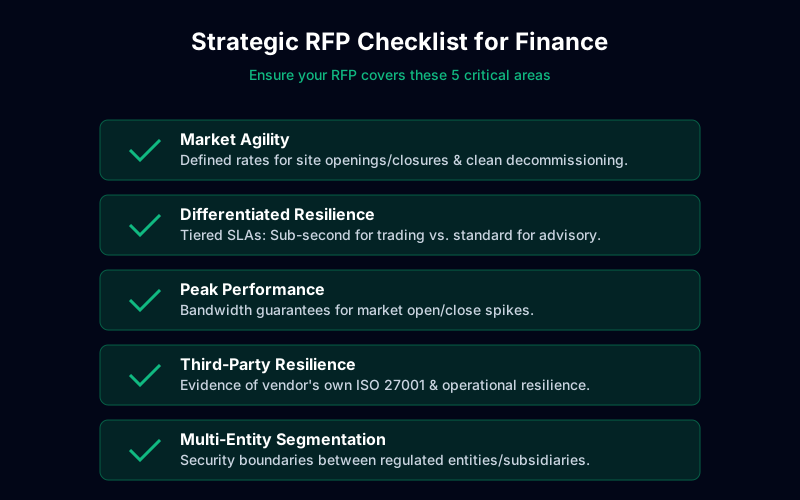
Sector-Specific Requirements Often Overlooked
When building your RFP, ensure you include these five critical requirements often missed in standard templates:
1. Market Reconfiguration and Site Changes
Netify recommends that financial services RFPs explicitly define expected rates of site openings, closures and service relocations over the contract term, with contractual obligations for rapid provisioning and clean decommissioning.
Financial services operations frequently reconfigure in response to market conditions, regulatory changes and strategic decisions. Solutions requiring lengthy lead times for circuit installation or complex decommissioning processes can delay business changes and therefore RFPs should specify maximum acceptable provisioning times for new locations and decommissioning procedures that don't leave organisations paying for unused circuits.
2. Differentiated Resilience by Site Type
Financial services organisations tend to specify uniform connectivity standards across all locations, leading to over-investment in small sites and under-investment in critical locations.
RFPs should define site tiers with different resilience requirements - trading floors and payment processing centres require near-continuous availability with sub-second failover, whilst advisory offices might tolerate brief outages with appropriate client communication protocols. Backup connectivity types and failover performance targets should vary accordingly, allowing vendors to propose cost-effective solutions that protect transaction-critical services appropriately without creating unnecessary costs.
3. Peak Period Performance
RFPs typically specify average bandwidth requirements without acknowledging that financial services networks experience predictable demand spikes during peak trading activity periods.
Requirements should specify peak period bandwidth needs (market open/close, major economic announcements, month-end processing) and define acceptable performance degradation during congestion, with vendors explaining how their solutions handle traffic prioritisation when demand exceeds capacity.
4. Third-Party Resilience and Vendor Assurance
With the FCA's operational resilience deadline now passed, regulatory focus has shifted to the resilience of third parties. RFPs should include specific questions about how an SD-WAN vendor's own infrastructure meets FCA operational resilience standards, their own important business services and impact tolerances, and evidence of their scenario testing.
Financial services organisations should verify their chosen vendors' own security certifications (ISO 27001, SOC 2) and request evidence of how the vendor would support the business's operational resilience requirements during disruption events.
5. Multi-Entity and Regulated Subsidiary Requirements
RFPs should specify whether different regulated entities within a financial services group will share network infrastructure and what security boundaries must exist between different legal entities, regulated subsidiaries and offshore operations.
Financial services increasingly operates across regulatory boundaries, and network solutions must support secure information sharing whilst maintaining appropriate access controls and audit separation.
How do network challenges differ between enterprise and mid-market financial organisations?
Whilst we've detailed many common issues experienced by the financial services industry as a whole, financial organisations at different scales face fundamentally different network challenges and understanding these distinctions is essential for appropriate solution selection.
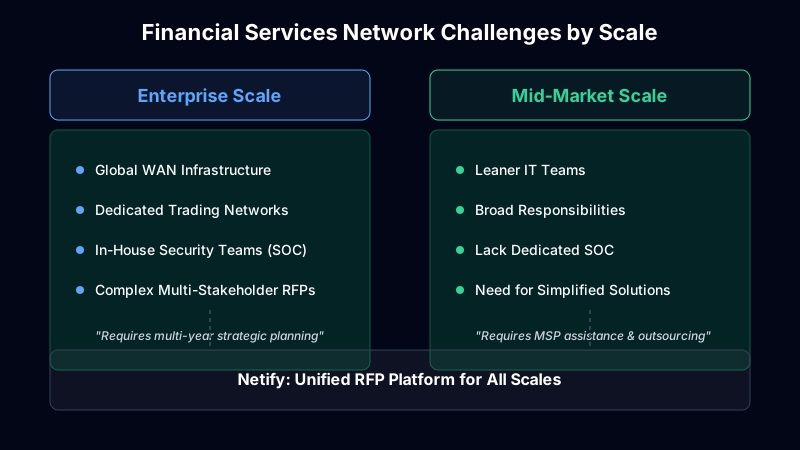
Enterprise financial organisations typically operate hundreds of locations with dedicated network operations centres, in-house security teams and complex network architectures including dedicated trading networks, enterprise security operations centres and global WAN infrastructure.
Given this, SD-WAN RFP procurement decisions will likely involve multiple stakeholders across IT, trading technology, information security and compliance, with formal approval processes and multi-year strategic planning cycles.
One consideration that tends to be more specific to enterprise organisations is that they often run multiple business lines (retail banking, investment banking, wealth management) requiring differentiated service levels and potentially separate network domains. This may mean that, in the event of an SD-WAN RFP they should detail any contractual obligations to maintain relationships with multiple carriers, exchange connectivity providers and market data vendors.
Mid-market financial organisations - including boutique wealth management firms, regional building societies and specialist lenders - operate with leaner IT teams, and network decisions are typically made by smaller teams with broader responsibilities, requiring solutions that are more simplified.
These organisations typically lack dedicated security operations centres and therefore should consider managed service provider assistance or tailoring RFPs for solutions with integrated security capabilities and outsourced security monitoring.
How does Netify help financial services businesses simplify vendor selection and the RFP process?
Netify operates as a neutral SD-WAN and SASE marketplace that helps financial services organisations navigate vendor selection without vendor bias - providing our intelligent RFP builder tool that guides your business through defining specific requirements, covering network topology, site types (branches vs. trading floors), compliance obligations (FCA, PCI DSS), resilience expectations and operational constraints. This structured approach reduces the time taken to create an effective RFP and ensures that requirements are comprehensively specified before vendors are engaged.
Our marketplace connects financial organisations with curated SD-WAN and SASE vendors and managed service providers, who will each respond to the same structured RFP, enabling direct comparison based on consistent criteria. We support both enterprise and mid-market financial services businesses, with RFP templates and guidance tailored to the full range of sector-specific requirements including trading system prioritisation, market data handling and multi-site resilience.